Who Is Wall Street? The Complete Story Behind the World’s Most Powerful Financial Hub
Introduction
When people hear the term Wall Street, they often think of wealth, stock markets, powerful investors, and global finance. But Wall Street is not a person—it is a historic place that has grown into a powerful symbol representing the entire financial system of the United States and, in many ways, the global economy. Located in New York City, Wall Street has evolved from a simple colonial street into the beating heart of modern capitalism. Over centuries, it has witnessed economic booms, devastating crashes, and groundbreaking innovations that shaped the financial world we know today. Understanding Wall Street means understanding how money moves, how markets operate, and how global economies are interconnected in today’s fast-changing world
Quick Bio of Wall Street
| Category | Details |
|---|---|
| Name | Wall Street |
| Type | Financial District / Symbol of Finance |
| Location | Lower Manhattan, New York City, USA |
| Established | Named in 1653 (Dutch Colonial Era) |
| Famous For | Stock Markets, Banking, Investment |
| Key Institution | New York Stock Exchange |
| Global Role | Center of U.S. and Global Finance |
| Symbolism | Capitalism, Wealth, Economic Power |
The Origin of Wall Street
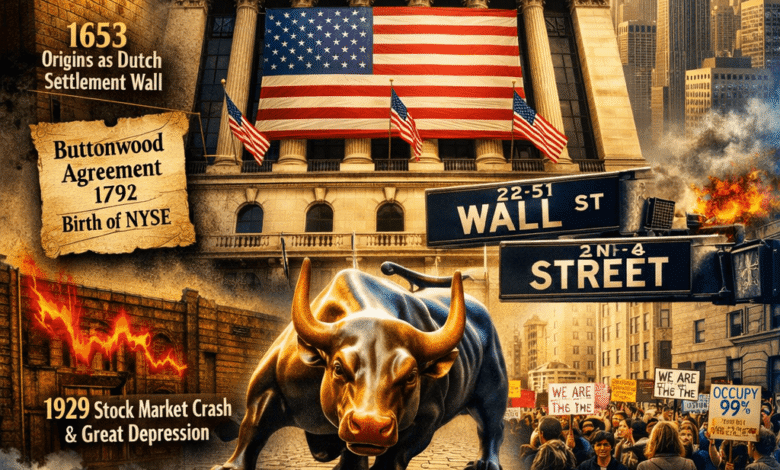
The story of Wall Street begins in the 17th century when Dutch settlers arrived in what was then called New Amsterdam. In 1653, they built a wooden defensive wall to protect their settlement from potential threats. This wall marked the northern boundary of the colony and served as a safeguard against invasions. Over time, the wall was removed in 1699, but the name “Wall Street” remained. What started as a simple defensive structure eventually became one of the most powerful financial locations in the world. This transformation reflects how historical events can shape the identity of a place far beyond its original purpose
The Birth of Financial Markets
The financial importance of Wall Street truly began in the late 18th century. A key moment came in 1792 with the signing of the Buttonwood Agreement. This agreement was made by a group of stockbrokers who decided to create a more organized system for buying and selling securities. It marked the beginning of structured financial trading in the United States. From this agreement emerged the New York Stock Exchange, which would go on to become one of the largest and most influential stock markets in the world. This early step laid the foundation for modern financial systems and established Wall Street as a center of economic activity
Rise to Power in the 19th Century
During the 1800s, Wall Street experienced rapid growth and transformation. As New York became a major trade and commerce hub, financial institutions began to concentrate in the area. Banks, brokerage firms, and investment companies set up offices, turning Wall Street into a bustling center of financial activity. The development of infrastructure and the expansion of trade helped strengthen its position as the financial capital of the United States. By the end of the 19th century, Wall Street had firmly established itself as a place where major financial decisions were made, influencing not just the U.S. economy but also global markets
Key Institutions and Their Role
At the core of Wall Street’s influence are its powerful institutions. The New York Stock Exchange stands as a central pillar, facilitating the buying and selling of stocks for companies around the world. Another major institution is the Federal Reserve Bank of New York, which plays a critical role in implementing monetary policy and maintaining financial stability. In addition to these, numerous investment banks, hedge funds, and financial firms operate in and around Wall Street. These institutions manage vast amounts of money and make decisions that can impact global economies, interest rates, and employment levels
Major Historical Events That Shaped Wall Street
Wall Street’s journey has not been without challenges. One of the most significant events was the Wall Street Crash of 1929, which led to the Great Depression. This crisis caused widespread unemployment, poverty, and economic hardship, leading to major reforms in financial regulation. Another important event was the Financial crisis of 2007–2008, which exposed weaknesses in the financial system and triggered a global recession. Additionally, the Occupy Wall Street movement highlighted public concerns about inequality and corporate power. These events demonstrate that Wall Street is not only a place of opportunity but also a center of risk and controversy
Wall Street as a Global Symbol
Today, Wall Street is much more than a physical location. It has become a global symbol of capitalism, investment, and financial power. When people talk about Wall Street, they are often referring to the entire U.S. financial system. Its influence extends far beyond New York, affecting markets and economies around the world. Decisions made on Wall Street can impact everything from stock prices in Asia to currency values in Europe. This global reach makes it one of the most important financial centers in the world and a key driver of economic growth and innovation
Modern Transformation of Wall Street
In the modern era, Wall Street has undergone significant changes. With advancements in technology, financial trading has become largely digital, allowing transactions to occur in milliseconds across global markets. Many firms no longer rely solely on physical offices on Wall Street, yet the name continues to represent the financial industry as a whole. Despite these changes, its importance has not diminished. Instead, Wall Street has adapted to the digital age, maintaining its role as a leader in finance and investment while embracing new technologies and global connectivity
Criticism and Controversies
While Wall Street is often associated with success and innovation, it has also faced criticism over the years. Critics argue that it sometimes prioritizes profits over people, contributing to economic inequality and financial instability. Events like the 2008 financial crisis raised questions about regulation, accountability, and ethical practices within the financial industry. At the same time, supporters of Wall Street highlight its role in driving economic growth, creating jobs, and providing opportunities for investment. This balance between opportunity and risk is a defining feature of Wall Street’s identity
Conclusion
The story of Wall Street is a powerful example of transformation and influence. From its origins as a simple defensive wall in a colonial settlement to its current status as a global financial powerhouse, Wall Street has played a central role in shaping the modern economy. It represents both the opportunities and challenges of capitalism, serving as a hub for innovation, investment, and economic growth. Despite facing criticism and navigating crises, Wall Street continues to evolve, reflecting the dynamic nature of the global financial system. Understanding Wall Street is essential for anyone who wants to grasp how the world of finance truly works
FAQs About Wall Street
1. What is Wall Street known for?
Wall Street is known for being the financial center of the United States, home to major institutions like the New York Stock Exchange and a symbol of global finance
2. Why is it called Wall Street?
It is named after a defensive wall built by Dutch settlers in 1653 in New Amsterdam
3. Is Wall Street a person or a place?
Wall Street is a place, but it is also used as a term to represent the entire financial industry
4. What happened during the 1929 crash?
The Wall Street Crash of 1929 caused a massive economic collapse that led to the Great Depression
5. Why is Wall Street important today?
Wall Street remains important because it influences global markets, investment decisions, and economic policies worldwide